
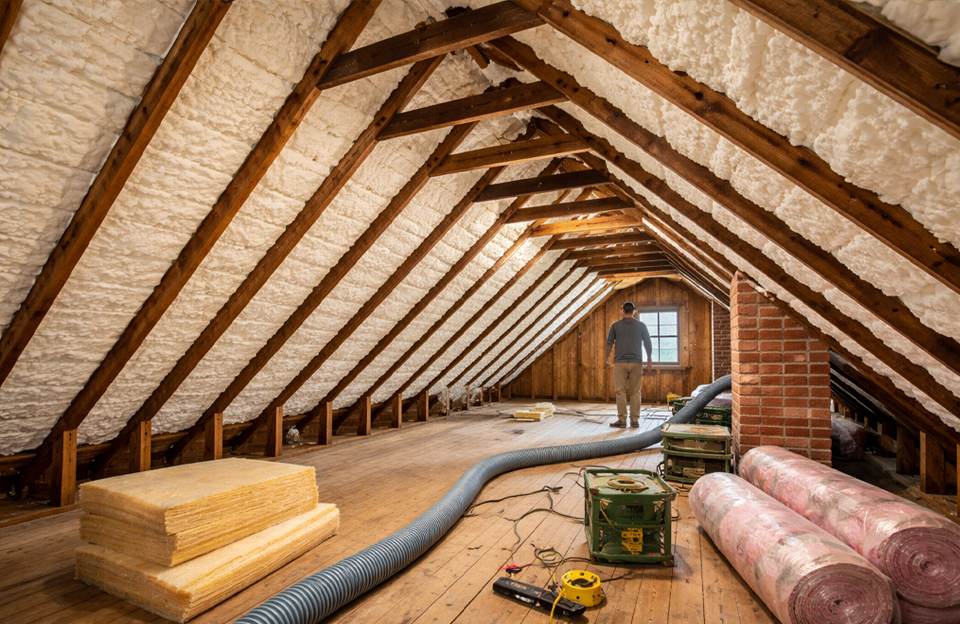
Insulating an older home can absolutely improve comfort and reduce energy waste — but it has to be done with a clear plan. Older houses manage air and moisture differently than modern builds, so adding insulation without understanding how the home “breathes” can create hidden problems instead of solving them.
Our approach focuses on air sealing first, moisture awareness second, and insulation selection third — so you enhance comfort, protect the structure, and preserve the character of the home without trapping moisture or creating long-term damage.
Why Older Homes Need a Different Insulation Strategy

Homes built before modern energy codes often “breathe” differently than new construction. That isn’t automatically a problem. Many older homes were designed to dry naturally through materials like plaster, wood sheathing, and solid framing.
The issue comes when insulation is added without understanding how the house manages air and moisture. Comfort problems like cold rooms, drafts, ice dams, and high utility bills usually point to air leakage first—not just low R-value.
Insulation works best when it’s part of a system that includes air sealing and moisture control.
Dense-Pack Cellulose: A Strong Fit for Many Older Homes

Dense-pack cellulose is often one of the best insulation options for older houses. It fills irregular wall cavities well and reduces airflow when properly installed.
Because older homes rarely have perfectly square or uniform framing cavities, cellulose adapts better than many batt products. It’s especially effective in exterior walls and attics when paired with proper air sealing.
It also provides solid performance per dollar, making it a practical upgrade for homeowners looking to improve comfort without overcomplicating the structure.
Mineral Wool: Durable and Moisture-Resilient

Mineral wool (rock wool) is durable, fire-resistant, and handles moisture better than many traditional materials. It maintains its shape over time and offers excellent sound control.
It’s often a smart choice in basements, bonus rooms, and finished attic spaces. When installed in the right wall or basement assembly, it supports drying potential instead of working against it.
Spray Foam: Best Used Strategically

Spray foam can dramatically reduce air leakage—but it works best in targeted areas, not as a blanket solution. Rim joists, band boards, and small transition areas are often ideal locations.
In older homes, completely encapsulating wall assemblies with foam without understanding moisture behavior can create long-term issues. Used strategically, though, it can be one of the most effective comfort upgrades available.
Fiberglass: Works When Details Are Right

Fiberglass insulation can absolutely perform well. The key is proper installation and air sealing first.
In older homes, gaps, compression, and open air pathways are common. When fiberglass is installed without sealing those leaks, much of its real-world effectiveness is lost.
When used correctly—especially blown-in fiberglass in attics—it can still be part of a solid insulation plan.
The Right Order: Air Seal, Fix Moisture, Ventilate, Then Insulate

Before choosing insulation, focus on:
1. Air sealing major leak points such as attic penetrations, rim joists, plumbing chases, and top plates.
2. Correcting moisture sources including gutter overflow, poor grading, basement dampness, and improper ventilation.
3. Confirming attic ventilation before dramatically tightening the home.
4. Insulate
When you address those fundamentals first, insulation performs the way it’s supposed to.
Risks of Skipping the Planning Step
Insulating without addressing air and moisture movement can lead to moldy attic sheathing, condensation inside walls, rim joist rot, and persistent drafts even after the upgrade.
The goal isn’t just to add insulation. The goal is to improve comfort without creating hidden structural problems.
How a Home Clarity Report Helps
A Home Clarity Report removes the guesswork. Instead of asking, “What insulation is best?” you can answer, “What insulation is best for this specific house?”
It creates a clear sequence—what to seal first, what to insulate next, and what to avoid—so improvements increase comfort, lower energy waste, and protect the structure long-term.
Clarity first. The right solution second.
Insulation problems are usually air-movement and moisture-management problems — and those affect comfort, utility costs, and even structural durability over time.
Let’s look at how your home is built and make sure any insulation upgrade improves comfort without creating hidden moisture risks.
Right person for the job
If you already know your insulation needs attention and would rather have a qualified professional handle it —
Need a trusted insulation professional who understands older homes? At no charge, We’ll introduce you to a vetted local pro in Northeast Ohio who can improve comfort the right way — without cutting corners or creating long-term issues.